From 10.7% to 39.8% net margin in one year with JSTFYD
Getting paid is the restoration industry's #1 problem. Here's how one Denver contractor solved it — same market, same team, same services.
The state of the industry
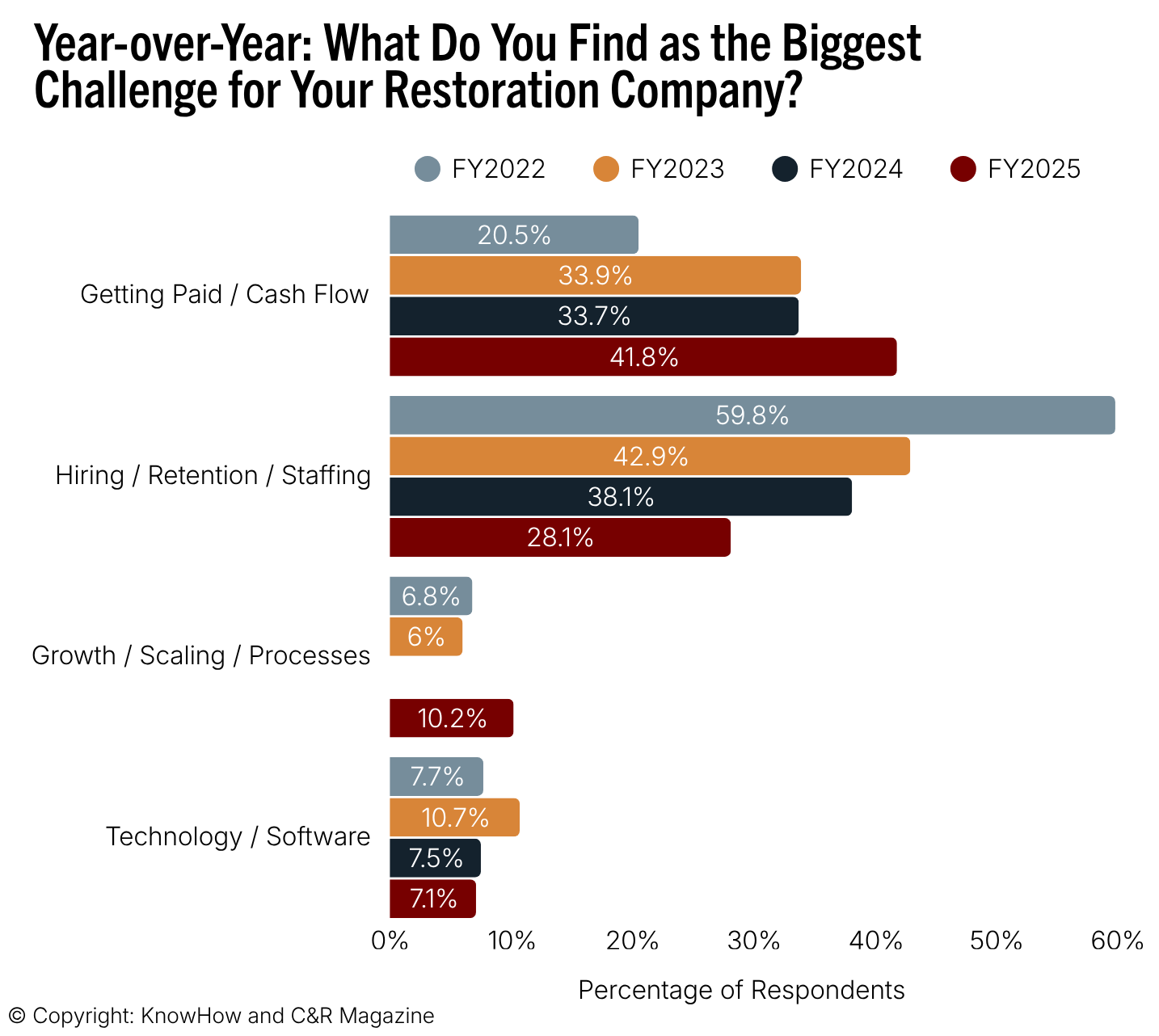
Across restoration, one problem now sits above every other: getting paid. In C&R Magazine's 2026 State of the Industry Report, 40.8% of restoration companies named getting paid as their single biggest challenge — far ahead of hiring (20.9%) and technology (6.6%). It isn't a one-year blip: getting paid first took the top spot in 2024 and has widened its lead since.
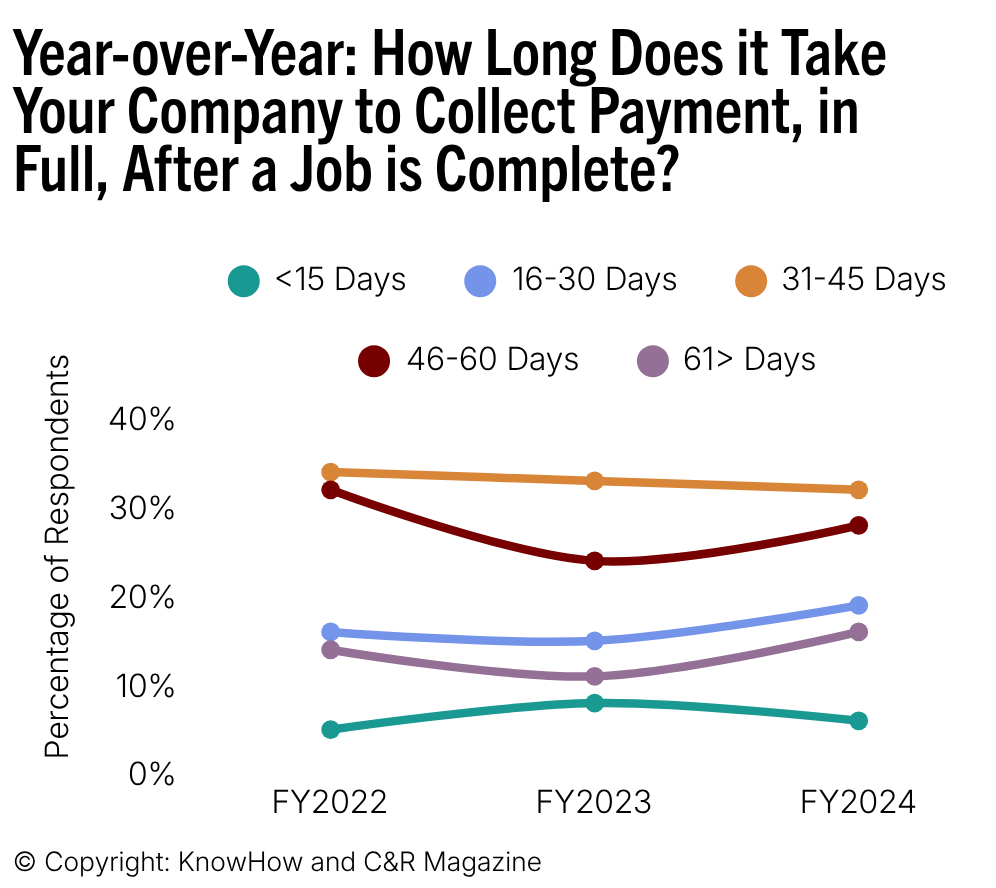
The pressure concentrates in two places: how long it takes to collect, and how hard carriers make it to get paid for legitimate work. As of late 2024, nearly three-quarters of restorers waited 30+ days to be paid in full after a job was complete, and getting carriers to approve supplements stayed slow with no guaranteed outcome. Every delayed payment and disputed line item is margin already earned but not yet collected.
What happened
Pure Restore is a disaster-restoration company serving the Denver metro with 25 employees. Over one year on JSTFYD's AI-powered claims-management software, revenue rose ~23.5% while profit rose ~358% — growth without the usual cost of expanding operations.
The clearest example is collections. Before JSTFYD, collecting from insurers took three employees — two of them six-figure roles with deep restoration experience. That's a large fixed cost devoted not to growth, but to recovering money already earned.
Today that entire workload is handled by a single administrative employee with no prior restoration or IICRC experience, working ~27 hours per week — and consistently out-collecting the old three-person team, because JSTFYD supplies the claim support and carrier-communication tools the work used to require. The gains were large enough that Pure Restore eliminated its Office Manager position entirely.
Nothing else changed
Almost nothing material changed outside the company between 2024 and 2025. Same crowded Denver market, same crews, same vendors and referral partners, same service offerings. The variables that usually explain a performance swing — new markets, new lines of business, a hiring spree, a marketing blitz, weather events — were not in play. What changed was internal: how the company documented, justified, communicated, and recovered revenue from insurance claims.
Facing the challenge
Industry commentary notes commercial claims often take 100+ days to pay and residential claims average 80+, straining contractor cash flow. Like most restorers, Pure Restore wasn't failing to win work — it was failing to fully collect on work already done. The friction lived inside the claims process:
- Documentation that wasn't consistent enough to defend a full estimate
- Carrier communications that ate hours and still produced underpayments
- “Delay, deny, defend” tactics that wore the team down into accepting less
- A heavy, expensive administrative load just to chase what was owed
The solution
Pure Restore adopted JSTFYD as a daily part of the workflow without changing any existing software or systems. It leveraged their field-software project documents — hydro reports, invoices, photo and testing reports — to support collections. JSTFYD streamlined:
- Insurance justification — defensible support for every estimate line, with citations (standards, regulations, OSHA)
- Carrier communications — faster, clearer, more consistent
- Estimate support — backing the numbers so they hold up
- Documentation consistency — the same high standard on every claim
- Administrative efficiency — less time per claim
- Combating “delay, deny, defend” — pushing back with documentation in minutes, not conceding after hours of labor
- Collections — recovering more, faster, with less labor
Responses that used to take hours or days now take minutes. JSTFYD was the bolt-on tool that synergized existing technologies to get them paid.
The results
Revenue went up. Costs went down. In a typical “growth” story, profit rises proportionally to revenue or less, because growth costs money. Pure Restore's year was the opposite — net margin nearly quadrupled, from 10.7% to 39.8%.
Before JSTFYD
3collections employees — two six-figure roles with deep restoration / IICRC experience.
After JSTFYD
1administrative employee, no prior IICRC experience, ~27 hrs/week — out-collecting the old team.
Our industry's #1 problem isn't finding work or hiring crews — it's getting paid for work already done. JSTFYD closes that gap.
See how JSTFYD closes the gap on your claims
Book a Demo- Figures are revenue and net profit for calendar years 2024 and 2025.
- Pure Restore is JSTFYD's first user. This is a single-company result, not a guaranteed outcome.
- Special thanks to C&R Magazine for survey results, charts and graphs — www.candrmagazine.com